Selected Publications
These publications reflect my interests in centromeres and non-model organisms. I aim to better understand the molecular mechanisms of chromosome division and its evolution by using the genetic diversity of the Saccharomycotina subphylum.
-
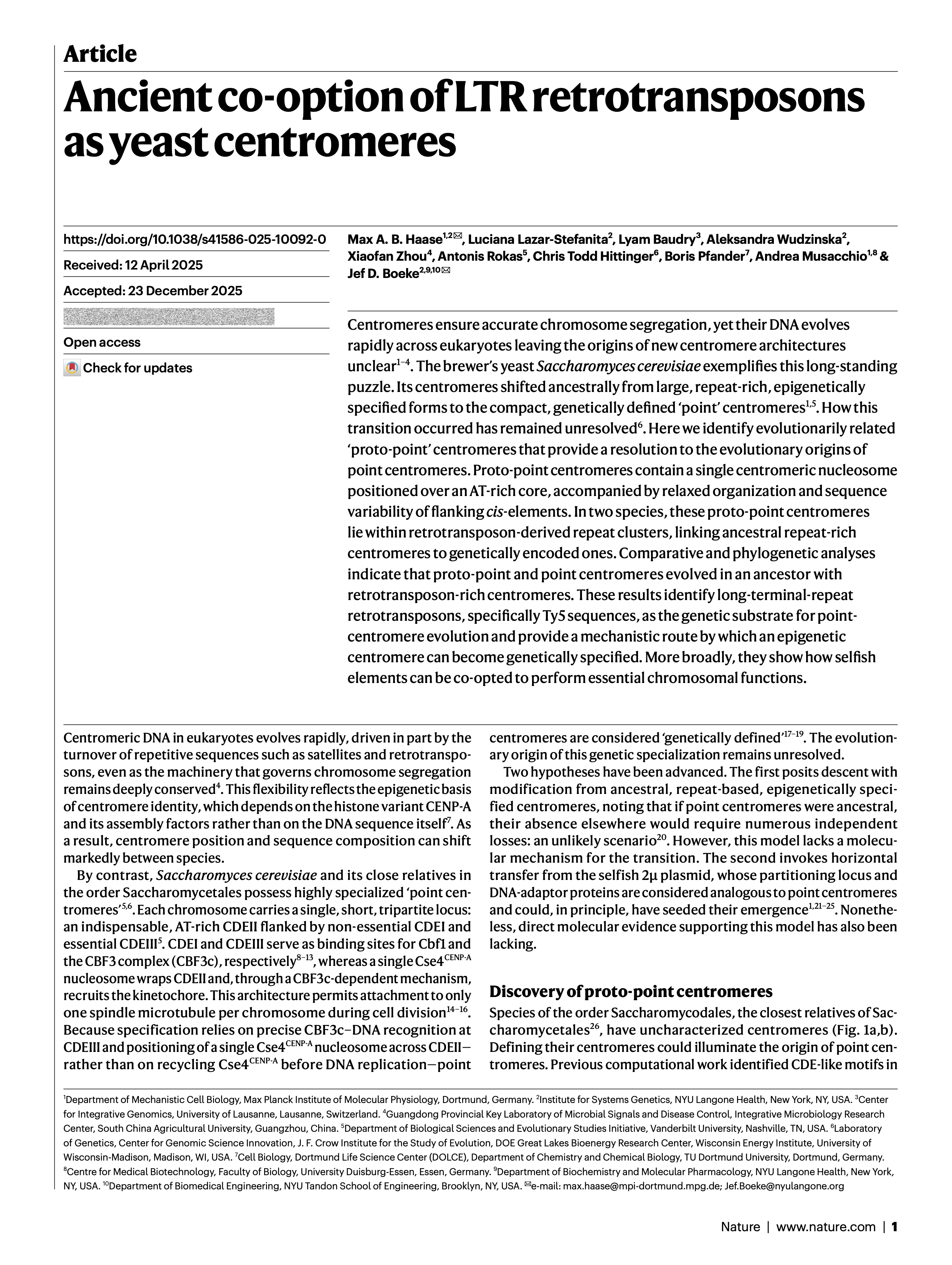 Haase MAB@, Lazar-Stefanita L, Baudry L, Wudzinska A, Zhou X, Rokas A, Hittinger CT, Pfander B, Musacchio A, Boeke JD@. Ancient co-option of LTR retrotransposons as yeast centromeres. Nature, 2026
In this work, we reported the discovery of evolutionarily related “proto-point” centromeres, which shed light on how yeast point-centromere architecture evolved—specifically, by linking their origin to selfish LTR retrotransposable elements.
Read the News & Views from Adele Marston covering our work here!
-
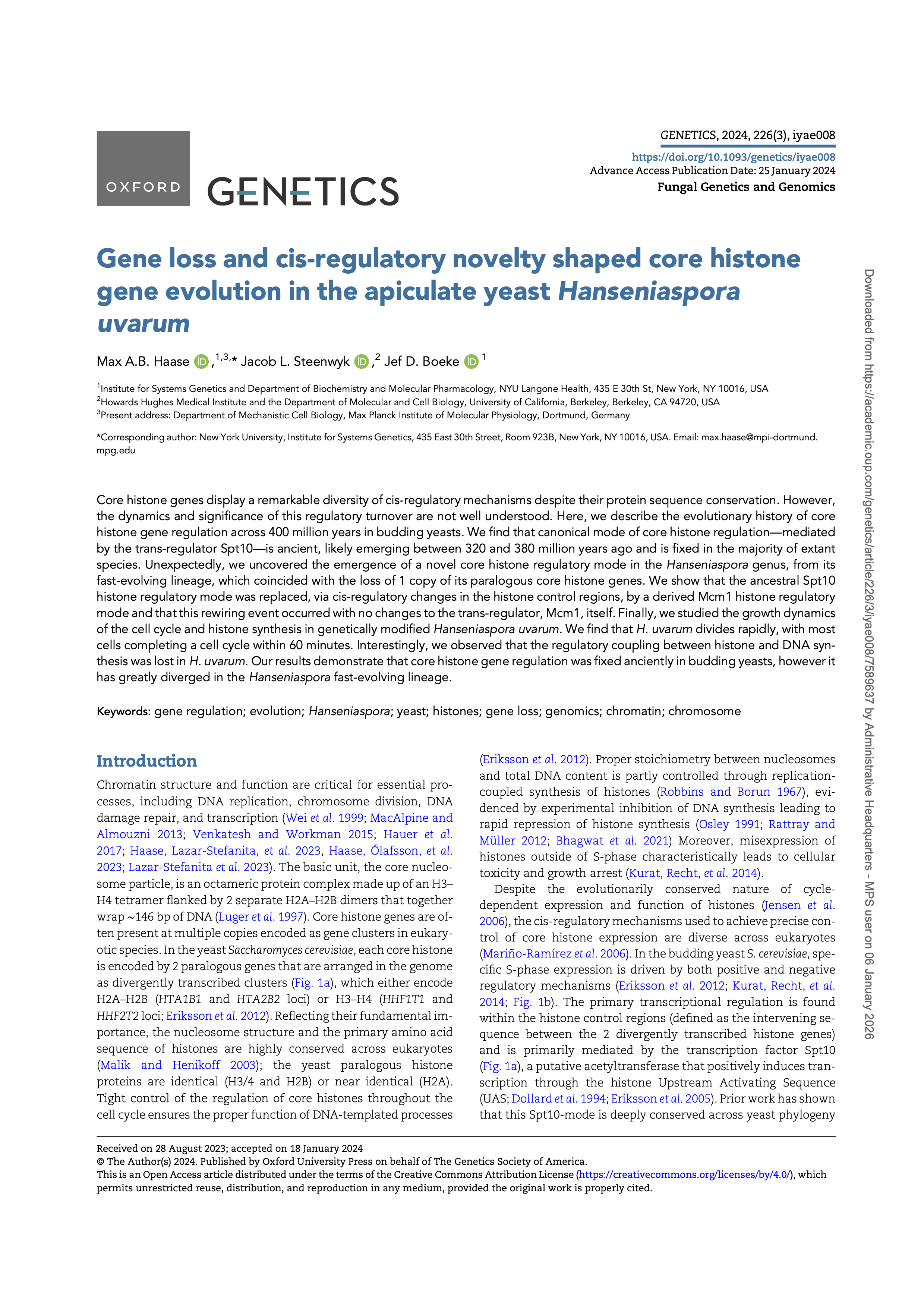 Haase MAB@, Steenwyk JL, Boeke JD. (2024). Gene loss and cis-regulatory novelty shaped core histone gene evolution in the apiculate yeast Hanseniaspora uvarum. Genetics, 2024
This work represents my initial efforts to study the molecular biology of understudied yeast lineages. While S. cerevisiae is a workhorse model, it captures only a small sliver of yeast genetic diversity. Studying other lineages is therefore a fruitful way to understand how cellular systems evolve and how flexible essential processes can be—insights that, in turn, deepen our understanding of these systems as a whole. Surprisingly, we found that the anciently conserved regulation of core histone synthesis is profoundly different in H. uvarum, perhaps as an adaptation to its rapid cell cycle.
-
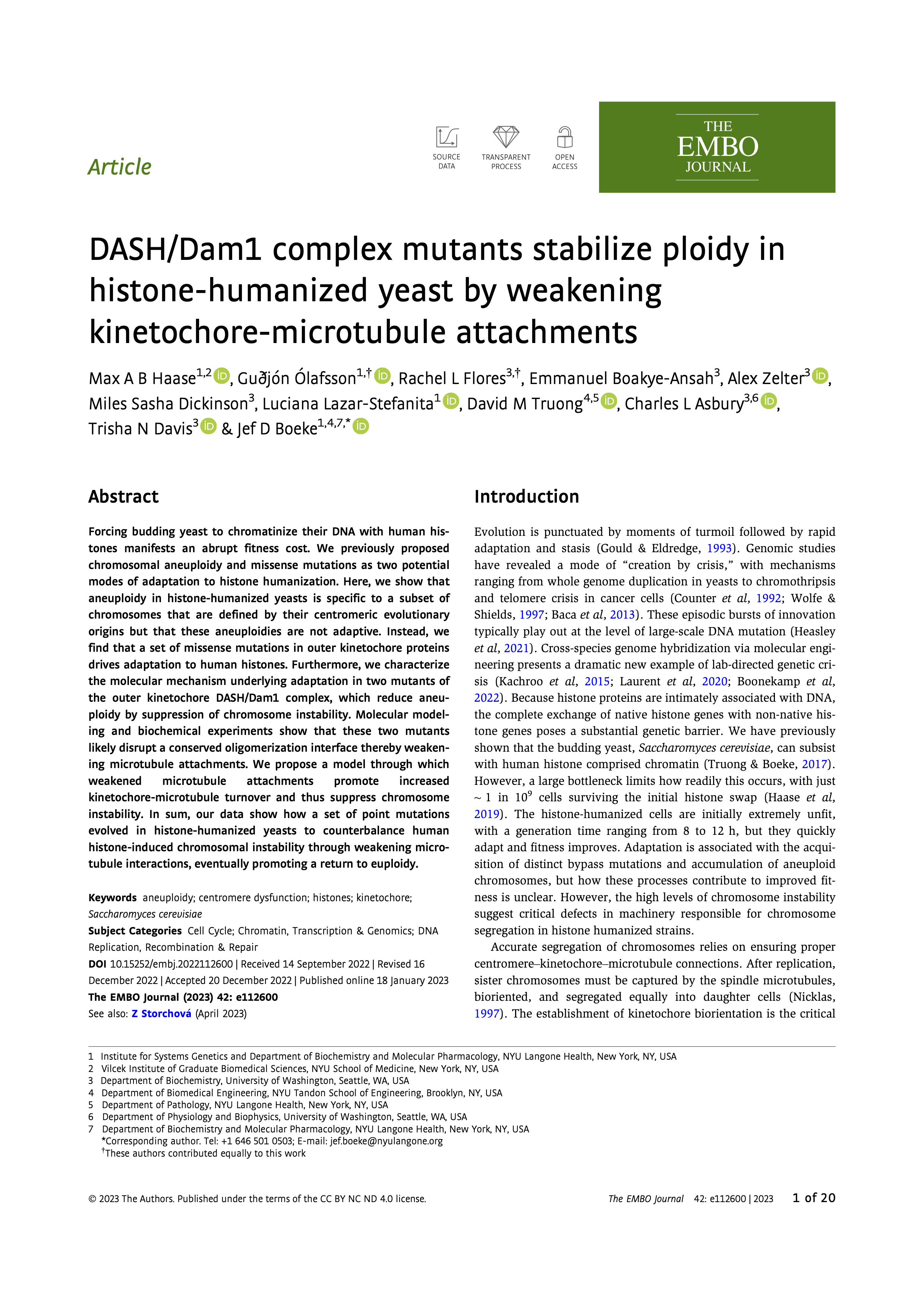 Haase MAB, Ólafsson G, Flores RL, Boakye-Ansah E, Zelter A, Dickinson MS, Lazar-Stefanita L, Truong DM, Asbury CL, Davis TN, Boeke JD@. (2023). DASH/Dam1 complex mutants stabilize ploidy in histone-humanized yeast by weakening kinetochore-microtubule attachments. EMBO Journal, 2023
This work represents my initial entry into the study of chromosome segregation and centromere evolution. In it, we asked how yeast adapts when its native nucleosomes are replaced with human ones. Surprisingly, the most effective route of adaptation was through adaptive mutations in the outer kinetochore, which weakened kinetochore-microtubule attachments.
Read the News & Views from Zuzana Storchová covering our work here!